
The useful answer
Ask which method suits the pipe, access and symptom, rather than booking by equipment name alone.
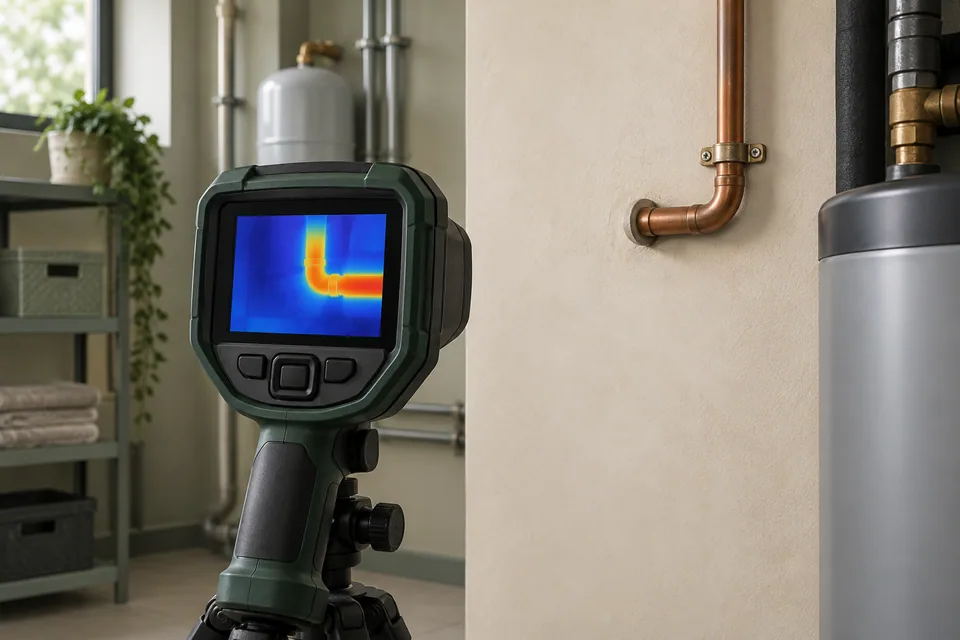
What thermal imaging contributes
A thermal camera detects surface temperatures. A temperature pattern can identify an area worth checking, especially when warm water or moisture changes the surface conditions. The camera does not see directly through a wall or photograph a concealed crack. Read our thermal water-leak inspection guide for its role in a broader investigation.
Heating, cooling, sunlight, insulation and air movement can affect a pattern. The provider should explain what further observations or measurements support its interpretation. A colorful image alone is not a repair specification.
What acoustic listening contributes
An acoustic investigation examines sounds carried through pipework or nearby surfaces. Pipe material, pressure, access, depth and surrounding activity affect the result. Tell the provider about traffic, machinery or other noise that may matter to the appointment.
Listening can be part of underground leak detection or a water-supply inspection. Ask whether the provider can investigate your actual pipe material and route. A capability statement about a tool should not be treated as a guarantee for every site.
Where meter observations and isolation fit
Meter records describe water use through a measurement point. They do not locate a source. The meter-movement guide helps prepare observations without assuming all measured flow is loss. A provider may use suitable isolation or testing to narrow the system, depending on permissions and equipment.
Leave testing of unfamiliar valves and pressurized systems to a qualified person. Fire systems, private supply equipment and other specialist assets need their own responsible operator. State those boundaries before arranging a general plumbing inspection.
Questions that make an equipment-led quote useful
Ask what question the proposed method will answer, what areas can be assessed and what happens if the initial result is inconclusive. Clarify whether findings will include a marked area, written notes or images, and whether confirmation needs further access.
For a suspected leak under a floor, compare slab-leak investigation with the supply-versus-drain distinction. For a wider site, define which buildings and branches are included. Our leak detection in Pahrump service pages help connect the method to a practical scope instead of treating it as a standalone promise.
Common questions
Can thermal imaging prove the wall contains a water leak?
No. A surface-temperature pattern is evidence to interpret alongside other observations; it is not direct proof of water behind the wall.
Will one method always avoid opening a surface?
No. Investigation can help focus access, but confirmation or repairs may still need an opening. Ask before any intrusive work.
Continue with the next question
Useful reading for this inspection
Slab leak or drain leak?: understand why the pipe system matters before anyone opens the floor. Prepare for a leak-detection visit: a practical checklist for homeowners, landlords and facility managers.
Browse all leak-detection articles